|
This first aired in March of 2020 on the US television news program "60 Minutes". The Elfstedentocht has now had the longest gap between races in its history. The previous was from the 1963 to 1985 tours. We are now still counting since the last Elfstedentocht in 1997. Will there ever be another one? There have been various times the last 20+ years where it has come close, but it just hasn't quite happened and been cold enough for long enough.
The report shows the Alternative Elfstedentocht at Weissensee, Austria. www.cbsnews.com/news/elfstedentocht-netherlands-skating-marathon-bill-whitaker-60-minutes-2020-03-08/
0 Comments
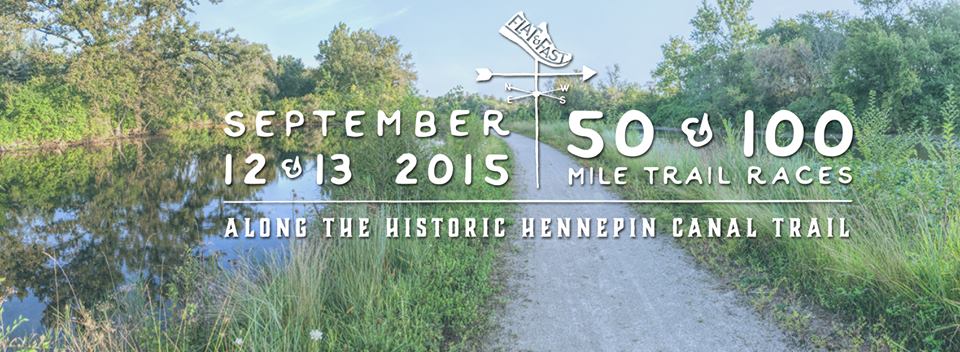 Well, almost as good as a marathon skate. This is the first ever ultramarathon on the Hennepin trail. It's a perfect route - flat, car-free, and the trees will at least help to give a break from the wind and sun to an extent (well, maybe occasionally). Scenic, and interesting. What a great flat, car-free route!
Here are some links: Hennepin Hundred registration and info: https://ultrasignup.com/register.aspx?did=29711 Easier link to tell people: http://muddrunner.com Hennepin Hundred on Facebook: https://www.facebook.com/hennepin100 Illinois Ultra Slam on Facebook: https://www.facebook.com/IllinoisUltraSlam 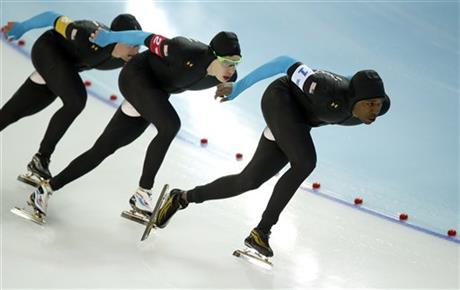 Illinois natives Shani Davis and Brian Hansen of Chicago with Jonathan Kuck of Champaign at the 2014 Winter Olympics. It's been a cold winter, but with a lot of snow cover and a busy schedule, the editor wasn't able to achieve a Hennepin Canal skate. Too much logistics. Let us know here at Illinoistocht if you had any winter adventures on skates or skis on either the Hennepin or the Illinois and Michigan Canals.
The Dutch dominated the 2014 Winter Olympics in terms of long track speedskating. Of 36 medals for 12 events, the Dutch dominated and won 23 total medals and 8 gold medals. Since 1992, in any sport with more than 18 medals awarded, this is the highest percentage of overall medals in ANY sport for a single country (Austria won 14 of 30 alpine medals in 2006) and ties the 75% of the gold medals South Korea had in short track in 2006 (6 of 8 gold medals). It was surprising in that some of the US skaters likely would have been more competitive given good performances at this season's world cup events. There have been a lot of theories, notably about the Under Armour speedsuit being slow or something about the training methods of the US skaters (which is on an ice set at altitude allowing for a nicer glide in their stroke), or numerous other theories. Of course the USA skaters raced in their World Cup suits in the later events at the Sochi 2014 games with similar results. As to the brine-icemix-altitude-glide theory, Shani Davis had had good performances with a first and a podium finish at near-sea-level Astana, Kazahkstan and Berlin, Germany, and other skaters from both USA and other nations fared better as well, so this may not explain things. Here's a theory--the Dutch have had one thing in recent years--very cold winters where it was very close that an Elfstedentocht would be held, a first since 1997. All these Dutch people grow up with skating as their national sport, and the last few years they've been able to have and canal skating and the Elfstedentocht in their dreams. So Shani, Brian, and Jonathan, good luck at the upcoming worlds in March, there's always next year, and just a reminder from this blog to think about canal skating. 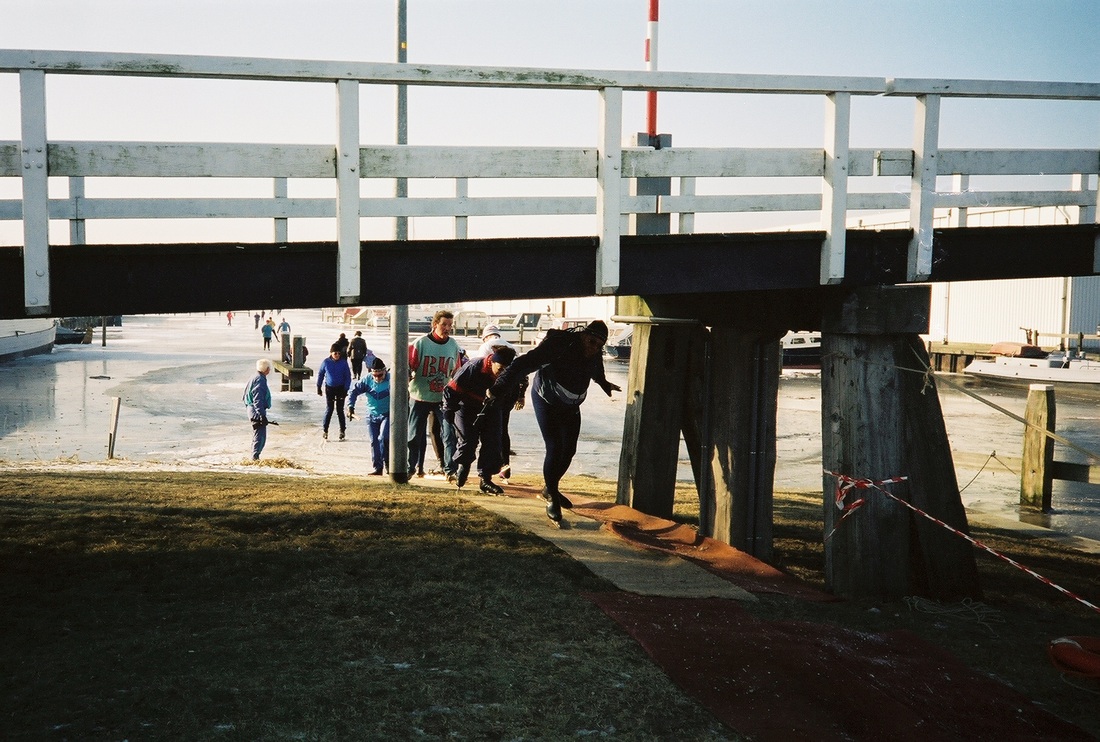
Winter is fast approaching in much of the country. Aside from the shorter days, perhaps this means skating on natural ice at some point.
Here's a photo from the Netherlands--they put out carpet scraps to walk over short stretches of land so you don't have to remove your skates or put on scabbards. 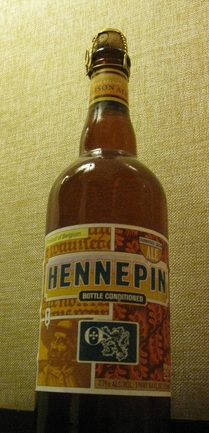 Hennepin beer bottle: brewed by Duvel of Belguim Its fall, and the cooler days and the approaching fall colors make for an excellent opportunity for an adventure on the Hennepin Canal, whether biking, hiking, or fishing.
This blog is now debating whether the "official" beer should be Natural Ice (in honor of the hope of a skating marathon on the Hennepin) or "Hennepin" beer. Tough call--this editor likes ales, but then again, Natural Ice is an Anheuser Busch product from St. Louis. (Well, given the ownership of A-B by In-Bev, I guess it's a "Belgian" beer too, in a way.) The beer, like the canal, and the county in Minnesota (where Minneapolis is located), is named after a Belgian explorer / missionary. As written on the back of the bottle: "Father Hennepin was the Belgian missionary who discovered Niagara Falls. Our Hennepin is a rare Saison Farmhouse Ale - pale, hoppy, crisp, and rustic, and like Tintin, Magritte, and Audrey Hepburn, Hennepin is famous, but not for being Belgian!" I like this quote, also on the back of the bottle: "And remember: 'The real voyage of discovery consists not in seeking new landscapes, but in having new eyes.' Proust". So even if you've been to the Hennepin Canal, fall makes an excellent time to visit the canal, and experience the changing colors of the trees lining the towpath and see the canal and its surroundings with new eyes. And maybe enjoy an ale or two afterwards! 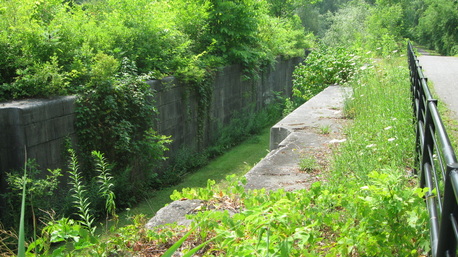 Abandoned lock section on the old Erie Canal. This blog decided it needed a ‘road’ trip this summer, and so it ventured to the original US-based canal, for a bicycle trip on the Erie Canalway Trail system in New York. Actually, the Erie Canal itself is now quite different from when it was originally completed in 1825, with the first major enlargement completed in 1862, and the present canal completed in 1918. The trail runs along not only the current canal configuration in places, but along ruins of the original canal and the enlarged canal as well as city streets (often where the canal used to run, but has been filled in and paved over, such as in downtown Syracuse). I flew into Buffalo on Jet Blue, which had a promotion that bikes fly free during July (a tie-in promotion with the Tour de France), rather than the normal airline gouge of up to $200 each way. I stayed in a hotel in downtown Buffalo and rolled out the next morning, heading north along the shores of Lake Erie and then the Niagara River. After 10 or so miles (16 km), the route turned inland towards Lockport. There, the trail picked up the canal and ran eastward for about 70 miles (112 km) right next to the present-day version of the canal. Several of the small towns made for a pleasant stop. This was badly needed, considering that the day had started out humid, with temperatures forecast to climb further for the day and to get even hotter during the week. I planned the trip at the last minute, so I hadn’t had the time to obtain the guidebook, and relied on my iPhone for planning where to stay each night. I had planned to stay in inns and hotels, which seemed fortunate as there didn’t appear to be as many camping options as I’d have thought there would have been. I stayed in Brockport at a chain motel and got dinner from a nearby supermarket. 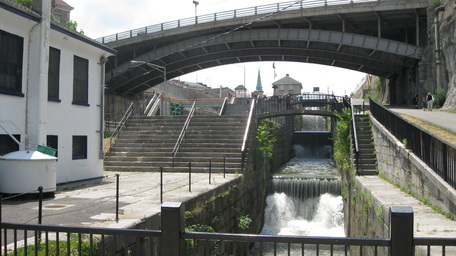 The old locks at Lockport are used as a spillway for the larger new locks barely visible on the left; at Lockport, the canal climbed the Niagara Escarpment, a geologic feature of upstate New York that includes the ridgeline for Niagara Falls. 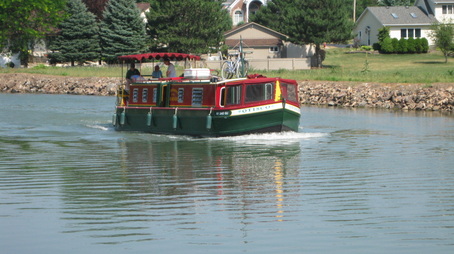 Recreational cruise on the Erie Canal. 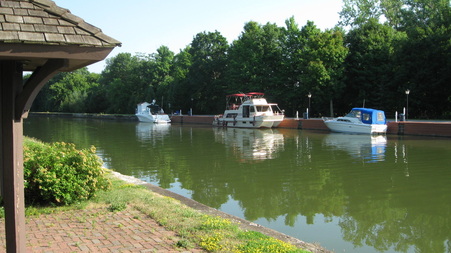 More typical recreational boating on the Erie Canal. The forecasts for the week called for record heat, so I set the alarm very early for me at 5:15 and was on the road by 6 am. (Indeed, Syracuse did set a record for the following day, and the city recorded the second hottest temperature ever recorded for any date, tying the second-highest mark of 101 F, or 38.3 C, reached only 3 times.) I planned to go pretty far the second day, fearing the even hotter temperatures to come. After running through the outskirts of Rochester, the route left the canal east of Palmyra. From there, the route was on roads for much of the next section, and as it was getting into late morning, the sun baked the roads in the rising heat. At Port Byron, the route finally rejoined a trail section, and from there to Camillus, a suburb of Syracuse, the trail ran along the old Erie Canal, not the current incarnation. Much of this section of the old canal seemed to have water in it, like the current Hennepin Canal, but with a lot of algae and other growth. 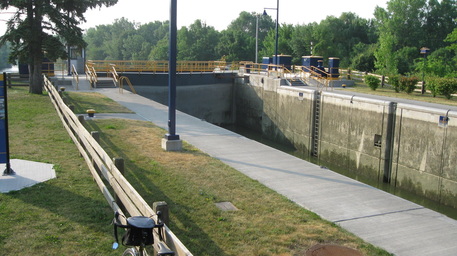 Modern lock on the present day canal. 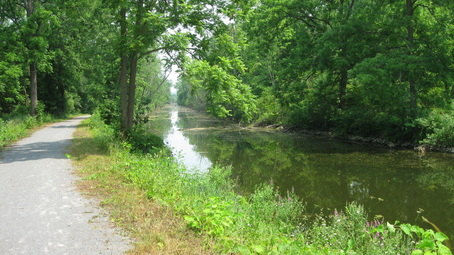 Old section of the Erie Canal. The third day was a very early start again with the route going through the streets of Syracuse. Although I had downloaded the route into my Garmin, my choice of downloads was too long and the route got truncated fairly early in the day the day before. The organized annual Cycling the Erie Canal Bike Tour had been the week prior, and the organizers had left painted route arrows on the streets, so furtunately I was able to utilize the arrows rather than have to deal with cue sheets and maps. It seemed to take quite a long time to get through Syracuse, and other than the downtown section, this was a rather long, dull, often industrial stretch of riding on streets. After finally reaching the eastern suburbs, I followed the arrows to another trail section. For the next 30 or so miles (~ 50km), the trail went through the Old Erie Canal State Historic Park. This was the day of the record heat, so I had planned to ride only until early afternoon, and finished the day with a lunch at Subway in Utica and then checked into a hotel. At the hotel, I appreciated the air conditioned comfort while I arranged logistics for the rest of the trip, including my finish in Albany, transportation home for me and for the bike (FedEx Ground), as well as my itinerary for my brief stay in New York City the following week. 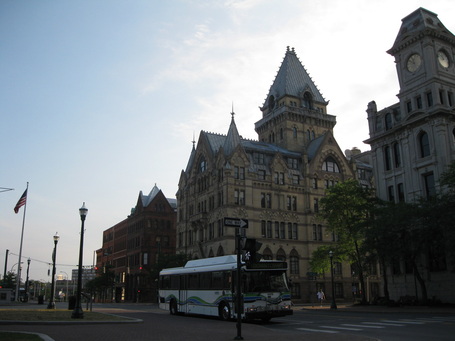 Downtown Syracuse--the original canal ran right through here, but now it is just city streets and a small park. 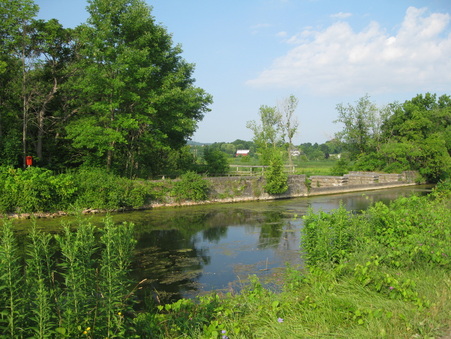 Aqueduct on the old canal in the Old Erie Canal State Historic Park, a 36 mile long linear park east of Syracuse. I started the final day again early, at around 6 am. Little Falls was an interesting old scenic city among the many sites I rolled by. I made sure to see Schoharie Crossing, which the Garmin and the iPhone certainly helped as it was off route a little bit and there was no signage alerting a trail rider that it was nearby. West of Schenectady, I picked up a rider out for an afternoon spin and we pedaled together on through a surprisingly interesting historic section of Schenectady towards Albany. The trail then ran alongside the Mohawk River, which now serves as the eastern end of the canal. I probably should have followed the other rider and made a beeline for the hotel I was staying at, but instead I went to the end of the trail which meant that this day ended up being quite long (116 miles, or almost 200km) while the end of the ride was anticlimactic as the trail ended at a small park rather than the confluence of the Mohawk and the Hudson. Oh well, the route was flat at least. I finished the trip with a coda of a ride in the Adirondack Park to the north. The lazy Saturday featured a leisurely pedal along a river and around one of the many Adirondack lakes, complete with scenes of summer as New Yorkers were out enjoying the water on a very warm summer Saturday. The entire trip made for a quick, yet fulfilling short summer tour. 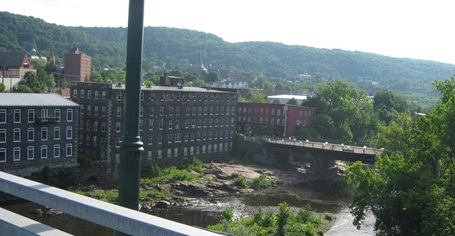 Little Falls, NY 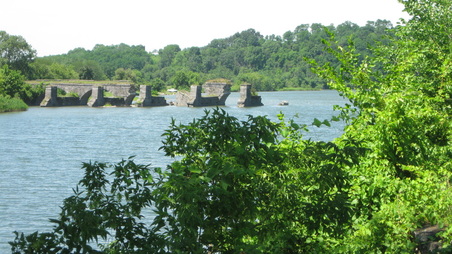 Schoharie Aqueduct ruins. 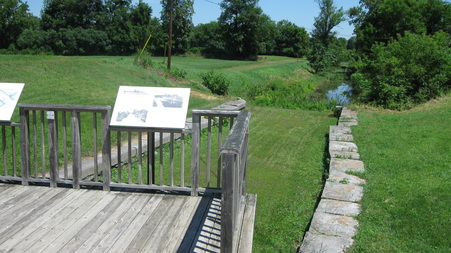 Original Erie Canal section at Schoharie Crossing State Historic site--here, all three major canal eras are represented--the original from the 1820s, the enlaged canal from the mid-1800s, and the present day canal dating to the early 1900s. 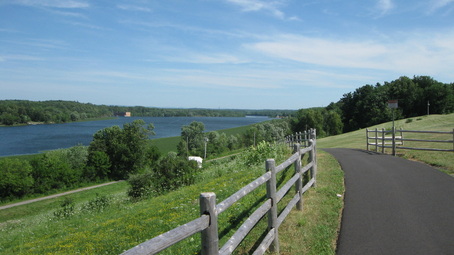 THe trail is paved and scenic in suburban Albany near the Mohawk River as it approaches the Hudson River. 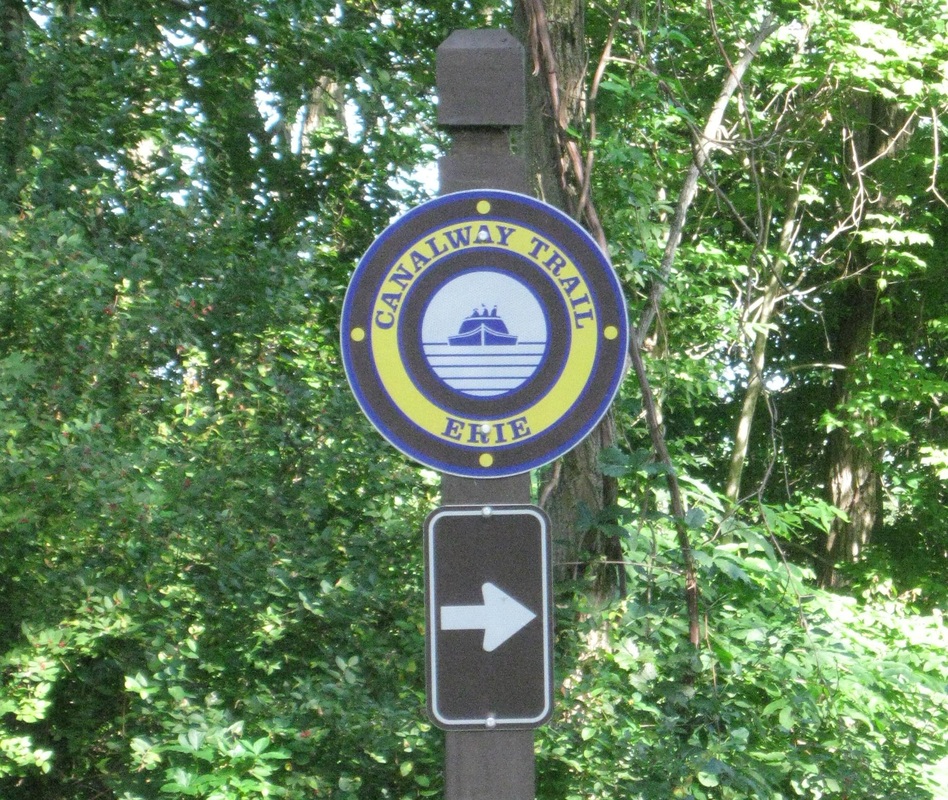  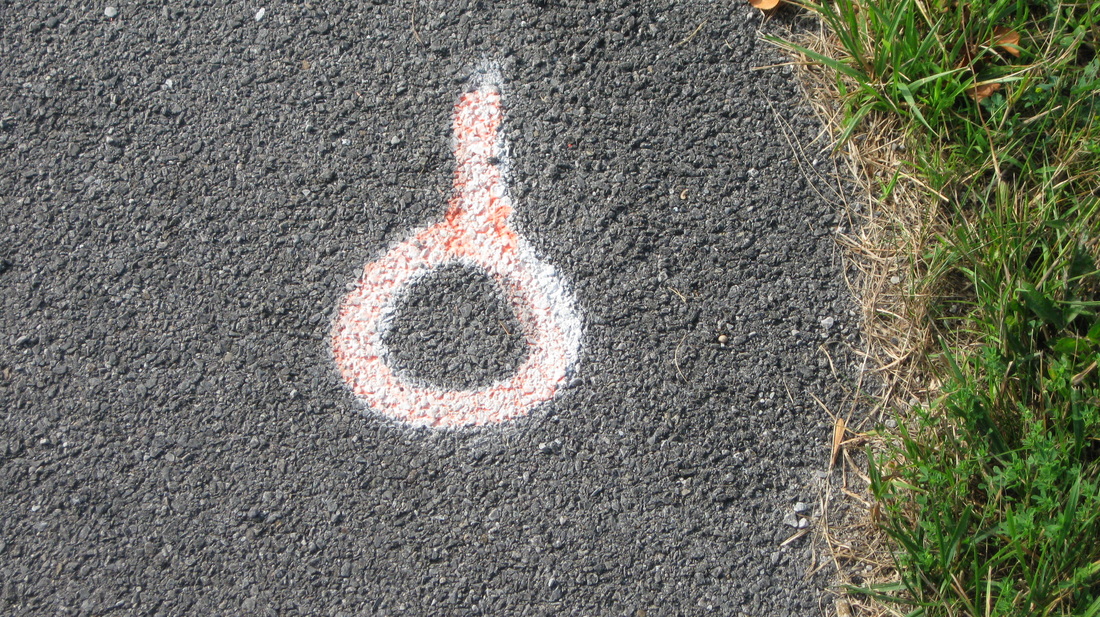 The route had some signs along the way (in the sections where the trail has been considered "complete", about 2/3 to 3/4 of the entire route, but the road marks for the group ride the previous week were more numerous, and along the entire route, not just the "finished" portions.
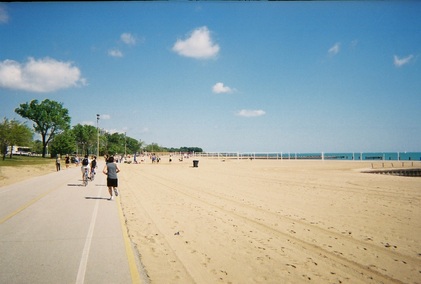 It's not the longest paved trail, but Chicago's Lakefront Bike Path is a favorite for many reasons. An update on my post about the longest paved bike trail or path for inline skating in the US. This is always difficult because the criteria can be managed so that a trail is “the longest” by including connections or out-and-back routing or other. Perhaps the longest is in Minnesota, which has many excellent trails, as noted by MN Trails' website. If I had to say which paved trail is the longest at this point, I’d say the Paul Bunyan trail (or see here for up-to-date distances) because it has a continuous, point-to-point distance of what will be 120 miles…but the exception is 2 miles of on-road connections in Bemidji means that right now it’s 105 continuous miles or with the connection 114 miles. I like the inline skater on the first page of its website, so it gets a nod in part for that.
The Lake Wobegon trail with the Central Lakes trail lists 103.7 miles of continuous point-to-point trail All these trails have spurs and connections, perhaps the longest “network” of paved trails is in Ohio (the Miami Valley rail trails) with a total of 339 miles of trails, many of which are connected in a spidery web. Have an idea about a "longer" trail? Send this blog a comment.  Orange tulips in bloom for the Dutch readers of this blog. It's almost summer, so a quick post looking back at the winter. The Hennepin Canal managed to freeze nicely this winter several times with the usual winter cold spells, but snow cover was a problem and rough ice a problem in other places. There wasn't, unfortunately, a nice window of several days with the perfect conditions to produce smooth, snow-free ice over the length of the canal. Wait 'til next year as they say. If you did have a good skate in the area, please share your stories and / or photos with this blog. Since this is Illinoistocht, a few kudos to the Illinois native speed skaters at the international level of the sport. Shani Davis (Chicago) won the overall World Cup circuit title for the 1500m distance and came in third for the 1000m standings, while he skated to gold at the Single Distance World Championships at the 1000m distance. In the longer distances, Jonathan Kuck (Champaign) placed 5th overall in the 5000m World Cup points standings. Other notable performances by US skaters included a 1st place in the World Cup standings for Heather Richardson (North Carolina) in the Ladies 1000m distance. Other Illinois skaters included Brian Hansen (Chicago), with several solid meets including a 6th overall in the Allround Championships, and a 3rd place finish at that meet in the 1500m. All in, the US long track skaters won 33 World Cup medals, 8 World Championship medals, and 2 World Championship titles. In Short Track, Champaign's Katherine Reutter won gold in the 1500m and bronze in the 1000m World Championships in March, and clinched the overall title in the 1500m as well. On the men's side for the US short track speed skaters, Simon Cho of Maryland won gold at the World Championships in the 500m, which also placed him atop the overall World Cup standings at that distance. As US Speedskating put it, it was "...the first time in 35 years an American duo has led the overall World Championship standings." Overall, the US short track skaters won 35 World Cup medals, 7 World Championship medals, and 2 World Championship titles. For more on the teams, and several other skaters from Illinois and other places in the USA, see US Speedskating or better yet their new site Up to Speed or on Universal Sports, which did televise the World Short Track Championships and a few of the long track events as well. Filmmaker Bud Greenspan recently passed away on December 25. He was known for his Olympic Games documentary films, which were not mere highlight compilations, but rather artistic documentaries which focused on "stories that resonate".
Universal Sports will air a nine-night retrospective of his work, featuring the Olympic Games from 1984 through 2006, beginning on New Year's night. For this editor, the best aspects are the compelling cinematography, lengthy profiles of the athletes, and voice-of-God narration employed in showing the preparation of the athletes and the drama of the competitions. The artistic documentaries of athletic competition remind me in a way of NFL films with John Facenda, but are more cinematic, and any history of film documentaries of the Olympic Games will almost always include Olympia by Leni Riefenstahl, but of course Greenspan doesn't have her troubling history. The Greenspan retrospective is worth the effort to seek out in the coming week on Universal Sports, which is available over-the-air or on cable in many U.S. cities, and tune in to at least a few of the broadcasts of work by this landmark filmmaker. The weather has been in the news recently, with the cold spell in Europe and the heavy snow in the upper Midwest a few weeks ago and in the Northeast this past weekend. They have had some shorter tours on snow-cleared courses in the Netherlands--a schedule can be viewed at the natuurijs section of KNSB's website under the Kalender Toertochten tab. Also, a video search of youtube is always entertaining and yielded a few recent videos I embedded here...I like the ATV snowplow in the video above that looks like an AMC Pacer that appears just before the 2 minute mark. Not sure what will happen with the canals in Illinois. The weather has been cold and the canals snow covered. A warm rain is coming Friday, which may wash away the snow and leave smooth "black ice" (best case) or may just simply leave slush and weak ice or open water. As always, firsthand reports are welcome--this editor probably will not be able to make a trip anytime soon. |
 Editor - JimThis blog weighs in on topics such as long-distance skating, the Illinois canals, cycling, and a variety of related (and occasionally not-so-related) topics. I'd like to correspond with others interested in skating the Hennepin and I&M canals. Archives
November 2020
Categories |
 RSS Feed